EXFIL NEWS / NUCLEAR EXPLAINER
Zaporizhzhia: why a switched-off nuclear plant still needs power
Europe’s largest nuclear power station has stopped generating electricity. Keeping its radioactive fuel safe still depends on a reliable supply coming in.
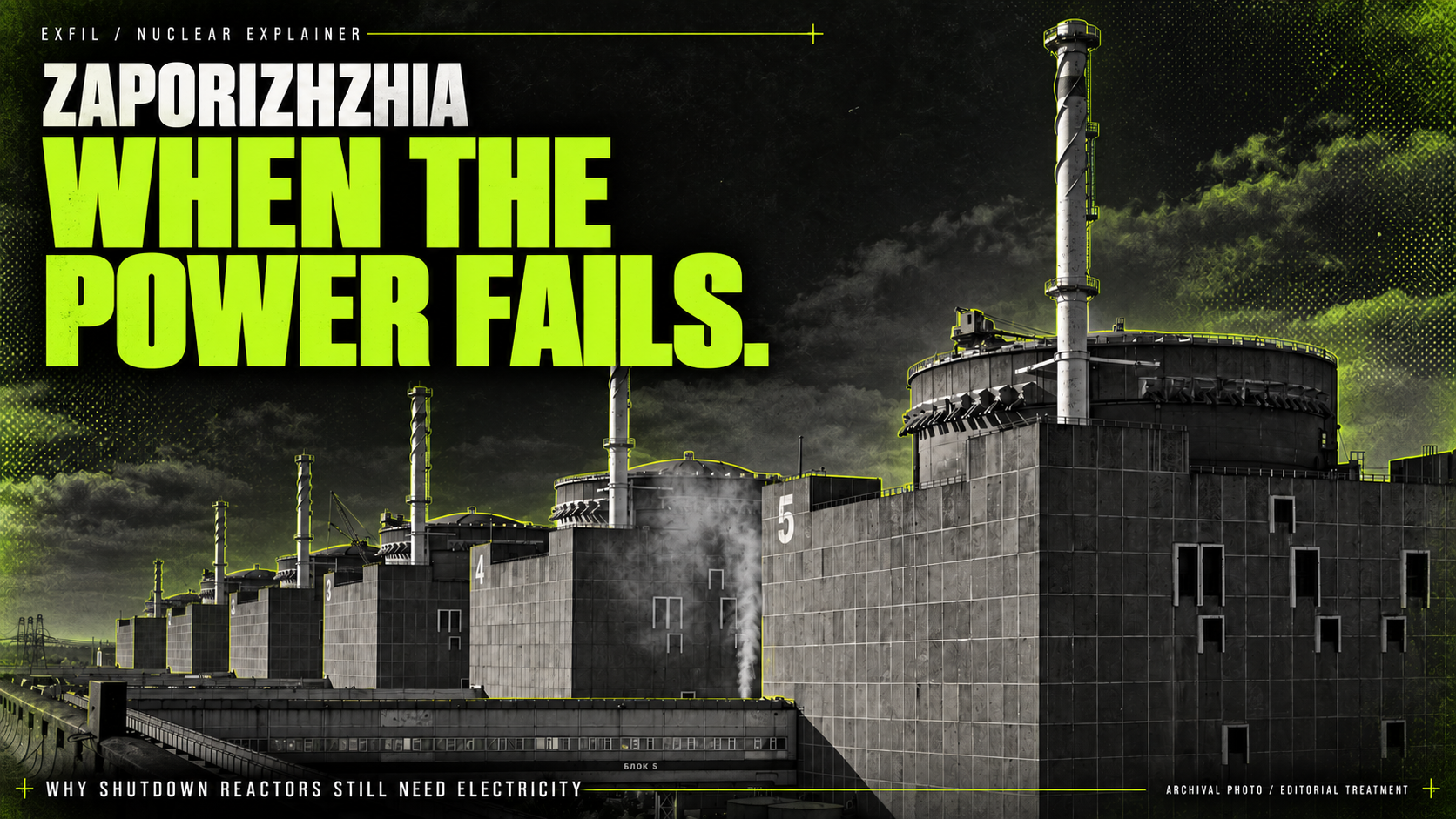

A nuclear power station losing electricity sounds like a contradiction. Surely the place that makes the power should be able to keep its own lights on?
At Ukraine’s Zaporizhzhia nuclear power plant, the answer is a matter of safety. Its reactors are shut down, but the fuel inside them continues to produce heat. Electricity keeps essential cooling and monitoring systems working. If the grid connection fails, backup generators take over. The serious danger comes if those backups also fail and operators cannot keep the fuel adequately cooled.[13]
What is the plant?
Zaporizhzhia is a sprawling complex near Enerhodar in southeastern Ukraine, occupied by Russian forces since March 2022. It contains six Soviet-designed VVER-1000 reactors. These are pressurised-water reactors: when operating, nuclear fission supplies heat that is used to produce steam and drive electricity-generating turbines.[2] [3] [4]
Each reactor was designed to generate about 1,000 megawatts of electricity. Together, their rated capacity is 6,000 megawatts, or 6 gigawatts, making Zaporizhzhia Europe’s largest nuclear power station. For global perspective, Japan’s seven-reactor Kashiwazaki-Kariwa site has a larger installed capacity of about 8.2 gigawatts. Those figures compare the plants’ designed electrical output, not what they are generating today.[2] [5]
Why does a stopped reactor need power?
The distinction matters because Zaporizhzhia’s six reactors have been shut down since 2022 and are in cold shutdown. They are no longer running the self-sustaining chain reaction used to generate electricity. Cold shutdown also means the reactor cooling water is kept below boiling temperature. It is a safer condition, but the fuel still needs care.[4] [6] [7]
The reason is decay heat. Splitting uranium atoms creates radioactive materials that continue releasing energy as they decay. Stopping the chain reaction does not stop that process. The heat output falls over time, but it does not instantly disappear. Used fuel removed from a reactor also produces heat, which is why it initially spends years in water-filled storage pools.[8]
So the plant has two jobs: keep the fuel cool, and keep operators informed about what is happening. Electricity powers cooling pumps, monitoring and control equipment, radiation instruments and other essential systems. Older fuel that has cooled sufficiently can be held in dry storage; Zaporizhzhia has such a facility, and this fuel does not need the same active water cooling as fuel in the reactors and pools.[1] [4]
What happens if the power goes out?
A lost power line removes a layer of protection. It does not automatically mean that cooling has stopped or radiation has escaped. Emergency diesel generators are intended to supply essential equipment during an outage. But they need fuel, maintenance, working connections and staff who can operate them. In a war zone, each of those requirements can become difficult to guarantee.[1] [9]
That vulnerability is already visible. In its 2 October update, the International Atomic Energy Agency said Zaporizhzhia was relying on one external power line and that diesel reserves remained low after nearly three weeks of generator use in August and September. Fighting was hampering fuel deliveries. The agency also reported delays to electrical maintenance and to work on an emergency generator.[9]
How dangerous could it become?
If external electricity and the necessary backup power were both lost, the emergency would become more serious. Without adequate heat removal, water could heat up and eventually boil away. If operators could not restore cooling or replace lost water, fuel could become exposed and overheat. Prolonged, severe failures can damage fuel and potentially lead to melting and a release of radioactive material. These are possible accident pathways, not the automatic outcome of a grid outage.[11]
The long shutdown gives operators valuable time. Zaporizhzhia’s fuel now generates far less heat than fuel in a reactor that has just stopped operating. The Dutch nuclear regulator said in September that, for the conditions it assessed, an accident could take approximately three weeks to develop after a total loss of power. That is an assessment of a particular situation, not a guaranteed countdown: damaged water systems, changing water levels or additional attacks could alter the circumstances.[10]
Fukushima shows why losing cooling matters. In 2011, its operating reactors shut down, but the tsunami disabled vital power supplies. Cooling failures led to fuel damage, hydrogen explosions and radioactive releases. Zaporizhzhia’s years out of operation mean its heat load and potential accident timeline are very different.[12] [10]
A major release could expose people nearby and contaminate surrounding land. Effects farther away would depend on how much material escaped, how it escaped and the weather. The plant’s size alone cannot tell us the scale of an accident: six reactors do not make a power cut a prediction of six simultaneous meltdowns.[4] [11]
The practical questions are whether cooling is working, whether backup equipment is available, and whether fuel, water and repair crews can reach the site. Zaporizhzhia can stop producing electricity. Keeping its nuclear fuel safe remains a continuing job.[1] [9]
Sources and reporting note: This explainer was reviewed on 7 October 2026. Its latest numbered IAEA situation update is dated 2 October. The Dutch regulator’s accident-time estimate describes the conditions it assessed, rather than a guaranteed safe period.
Source trail
- IAEA, Update 368, 25 September 2026 - safety equipment, emergency generators and fuel-conservation measures.
- Energoatom, Zaporizhzhia plant profile - six VVER-1000 units and 6,000 MW capacity.
- Energoatom, four years of occupation, 4 March 2026.
- GRS, Zaporizhzhia technical FAQ - reactor type, shutdown, dry storage and accident consequences. Background assessment dated 27 August 2024; its older numerical accident timings are not used as current predictions.
- IAEA OSART report on Kashiwazaki-Kariwa, 2015, introduction - seven units and 8,212 MWe installed capacity; not a claim about current operation.
- GRS, Nuclear energy worldwide 2026 - Zaporizhzhia reactors shut down since 2022.
- Energoatom, safety situation at Zaporizhzhia, 5 September 2026 - all units in cold shutdown.
- US Nuclear Regulatory Commission, spent fuel storage questions and answers - radioactive decay, residual heat and pool storage.
- IAEA, Update 369, 2 October 2026 - one external line, low diesel reserves and maintenance delays.
- Dutch Authority for Nuclear Safety and Radiation Protection, 11 September 2026 - long shutdown, water loss and its conditional accident-time assessment.
- US Nuclear Regulatory Commission, loss-of-coolant accident - fuel overheating and possible radioactive release.
- US Nuclear Regulatory Commission, lessons learned from Fukushima.
- IAEA, Update 366, 11 September 2026 - power supply, cooling and emergency generators.