A reported death. Conflicting accounts. Follow the evidence, the unanswered questions and the reporting as it develops.
WHAT IS KNOWN SO FAR
One death remains reported; its cause remains unconfirmed. WHO’s 6 October initial assessment: moderate-to-low risk for Irkutsk, low for Russia and very low for the WHO European region, subject to revision. AP reports Russia told WHO monitoring had concluded for 100% of identified contacts and tests found no dangerous infectious pathogens. These are attributed Russian claims. ECDC says limited information shows no reported secondary cases or evidence of sustained human-to-human transmission. A confirmed plague diagnosis remains unestablished.
One death remains reported; its cause remains unconfirmed. WHO’s 6 October initial assessment: moderate-to-low risk for Irkutsk, low for Russia and very low for the WHO European region, subject to revision. AP reports Russia told WHO monitoring had concluded for 100% of identified contacts and tests found no dangerous infectious pathogens. These are attributed Russian claims. ECDC says limited information shows no reported secondary cases or evidence of sustained human-to-human transmission. A confirmed plague diagnosis remains unestablished.
Source-reviewed reportingReviewed the U.S. Embassy Moscow health alert dated 6 October and added it to EXFIL’s Irkutsk reporting feed and timeline. The alert cites press reports, gives precautionary advice and reiterates the standing Russia travel advisory; it does not establish a diagnosis or transmission. Existing summary, counts and location evidence are preserved.Last reviewed
The 6 October alert cites press reports of suspected pneumonic plague and hospital quarantine measures; it does not confirm a diagnosis or transmission. It advises U.S. citizens locally to follow health-authority guidance, avoid affected facilities and seek care promptly for fever or respiratory symptoms. It reiterates the existing Level 4 Russia travel advisory, including advice to leave Russia; this is not a newly announced plague evacuation.
Reviewed source
Associated Press - reporting President Donald Trump’s remarks
Published 6 October at 21:19 UTC. Trump said he had scheduled a call with Putin soon about the possible plague case and expected to provide more information on 7 October. This report establishes no call outcome or precise call time. The planned discussion is a diplomatic development, not confirmation of the deceased worker’s diagnosis or onward transmission.
Published 6 October, reporting events on 2–5 October. Anonymous staff say institute employees were released on 4 October after three days of twice-daily swabs and normal work resumed on 5 October. Colleagues dispute the broken-tube account and say the cause was still under investigation. The report also describes precautionary psychiatric-clinic restrictions on 5 October, without an official notice. These are witness accounts, not diagnostic findings or evidence of transmission.
At its 6 October briefing, WHO assessed risk as moderate-to-low for Irkutsk, low for Russia and very low for the WHO European region, based on available information. WHO says the assessment will change as information arrives. No cause of death had been officially confirmed and laboratory testing was reportedly underway. This is a preliminary risk assessment, not confirmation or exclusion of plague in the deceased worker.
Reviewed source
Associated Press - quoting Russia’s message relayed by WHO
AP reports on 6 October that Russia told WHO medical monitoring had concluded for 100% of identified contacts and tests found no dangerous infectious-disease pathogens among contacts. This is newer than the earlier 60% release report, but completion of monitoring and release from quarantine are different measures. The statements remain attributed to Russian authorities; contact testing does not establish the deceased worker’s diagnosis.
Reviewed source
European Centre for Disease Prevention and Control
In its 6 October statement, ECDC says that, based on limited information, no secondary cases have been reported and there is no evidence of sustained human-to-human transmission. It is monitoring the event and communicating with WHO Europe. The statement describes pneumonia of unknown origin with suspected pneumonic plague; it does not confirm the deceased worker’s diagnosis or exclude all transmission.
Reviewed source
Reuters - reporting remarks by US Secretary of State Marco Rubio
Published 6 October at 11:17 UTC. Rubio said Russia should share more information and that Washington was watching closely. This is a diplomatic response to the unresolved circumstances, not diagnostic evidence or evidence of transmission.
Reviewed source
FEED STATUS
Showing the reviewed reading list.
THE STORY AS IT DEVELOPS
Latest developments.
Source-linked updates from our reviewed reporting, newest first.
Reading this timelineDates are source publication dates. Times, where available, are shown in Sydney time; date-only entries retain the source date. Reports and expert comments do not establish a diagnosis or spread.Situation reviewed . A new review does not necessarily mean a new development.
Associated Press - reporting President Donald Trump’s remarks
Published 6 October at 21:19 UTC. Trump said he had scheduled a call with Putin soon about the possible plague case and expected to provide more information on 7 October. This report establishes no call outcome or precise call time. The planned discussion is a diplomatic development, not confirmation of the deceased worker’s diagnosis or onward transmission.
Associated Press - quoting Russia’s message relayed by WHO
AP reports on 6 October that Russia told WHO medical monitoring had concluded for 100% of identified contacts and tests found no dangerous infectious-disease pathogens among contacts. This is newer than the earlier 60% release report, but completion of monitoring and release from quarantine are different measures. The statements remain attributed to Russian authorities; contact testing does not establish the deceased worker’s diagnosis.
Reuters - reporting remarks by US Secretary of State Marco Rubio
Published 6 October at 11:17 UTC. Rubio said Russia should share more information and that Washington was watching closely. This is a diplomatic response to the unresolved circumstances, not diagnostic evidence or evidence of transmission.
Reuters - quoting Rospotrebnadzor and a Shelekhov district official
Published 6 October at 10:32 UTC. Reuters reports Rospotrebnadzor said no plague cases were detected among contacts and no infectious diseases had been reported among institute staff in the preceding 10 days. It said tests found no work-linked microorganisms in the deceased woman’s body. A district official said 60% of quarantined people had been released. These are attributed statements, not published diagnostic records; the cause of death remains unresolved.
Reuters - quoting WHO spokesperson Christian Lindmeier
Reuters updated its 6 October report: Russia told WHO that no plague case had been recorded in Irkutsk and that identified contacts tested negative for dangerous pathogens. Reuters could not establish whether the deceased worker was tested or whether plague was ruled out in her case. The account relays Russia’s response; it does not independently verify the tests or determine her cause of death.
Reported 6 October. IrCity says the institute had planned a conference on plague and other dangerous infections for 21–22 October, before the incident. The outlet could not confirm whether it would proceed. This is institutional background, not evidence of an outbreak, laboratory accident or concealment.
GO TO THE ORIGINAL
Follow the source trail.
Traceable claims, preserved qualifications and direct links to the reporting.
What the labels mean
Reported: a source reports an event or possible case; sufficient primary diagnostic confirmation has not been obtained. Confirmed: a cited public health authority or published laboratory report explicitly confirms a human case. The clinical form must be stated before it is labelled pneumonic plague. Context: a reported link, not a separate case or a confirmed exposure site.
How numbers are handled
Cases, deaths and contacts are different measures. Observation, quarantine and precautionary admission do not automatically mean infection. Unknown values remain unknown. Regional contacts are not allocated to individual cities without evidence. A laboratory employee’s illness does not establish a laboratory escape.
Reviews and news feeds
This hub uses the same saved editorial review and news feeds as Irkutsk Live. It checks for updates when opened and every five minutes while visible. Headlines marked “not reviewed” do not change the situation assessment. The editorial review has its own timestamp; a warning appears after 12 hours. If an update fails, the last available data keeps its original date.
Russian and independent Russian outlets are grouped geographically, not treated as having identical editorial independence. Inclusion is not endorsement. AI assistance may be used to gather, translate and summarise reports; no clinical verification is implied.
Know the symptoms. Act early. Follow local health advice.
General informationThese health resources explain plague. Their inclusion does not confirm the diagnosis in this incident.
What it is
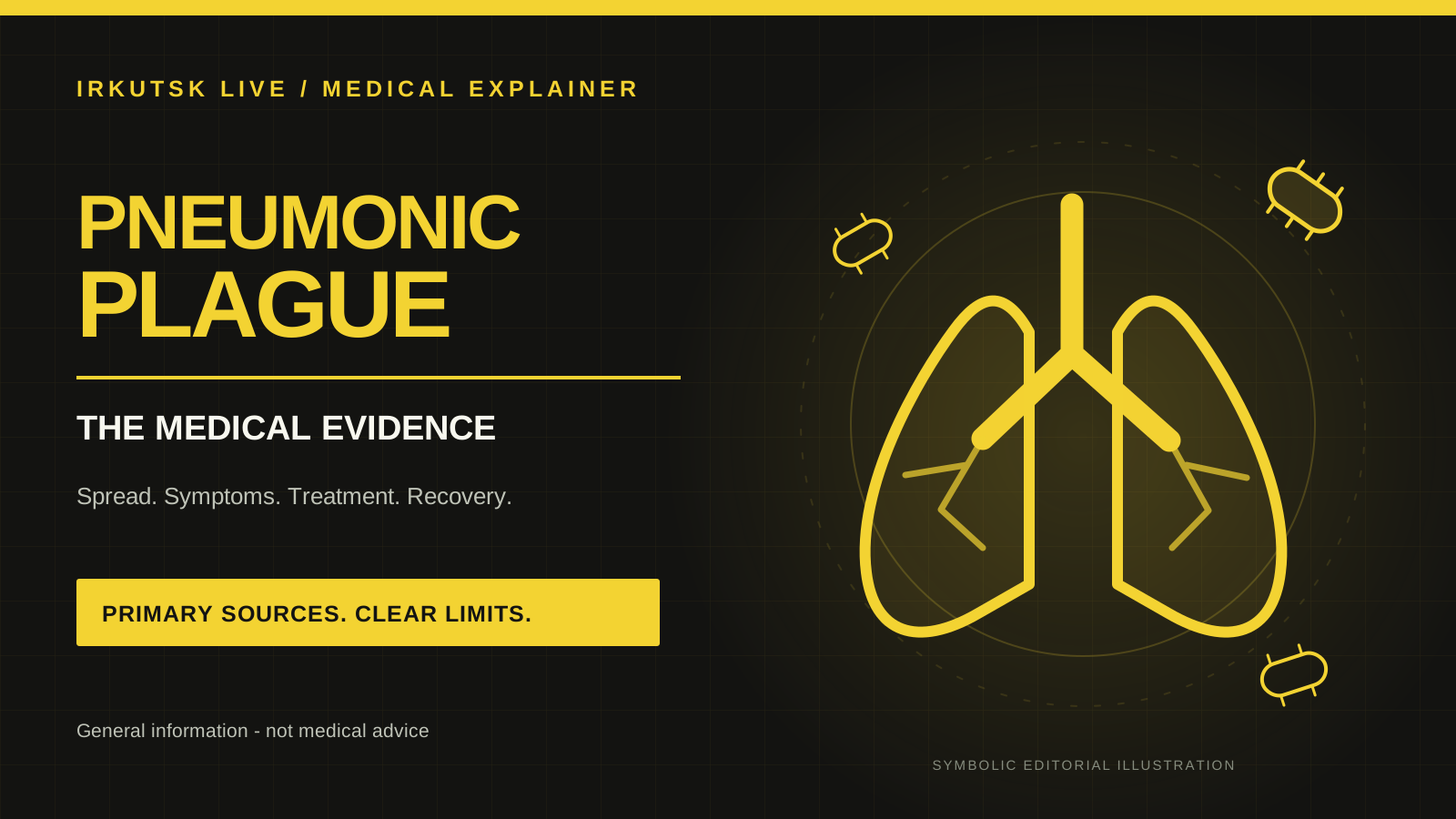
Pneumonic plague is a serious lung infection caused by Yersinia pestis bacteria. It can spread through infectious respiratory droplets during close contact.
Prompt antibiotic treatment can save lives. Untreated illness can progress rapidly.
Follow your local public health authority’s instructions. Close contacts may need preventive antibiotics prescribed by a clinician. Do not self-medicate. This information is general education, not a diagnosis or personal medical advice.
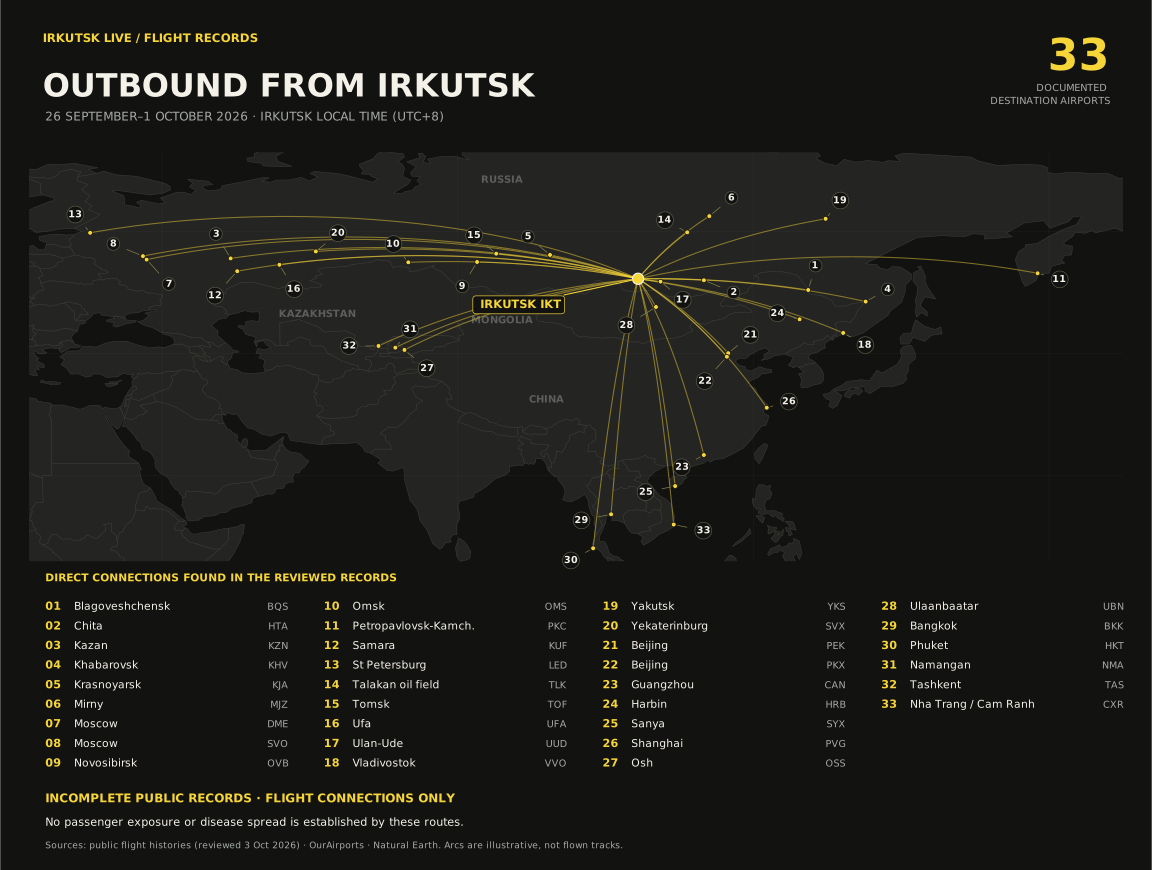
Reports can change. “Reported” does not mean confirmed, and “unknown” does not mean zero. Flight connections do not establish exposure or spread. Check source dates and follow official public health instructions.