EXFIL NEWS / NUCLEAR SECURITY
Zaporizhzhia: the gaps in Russia’s strike story
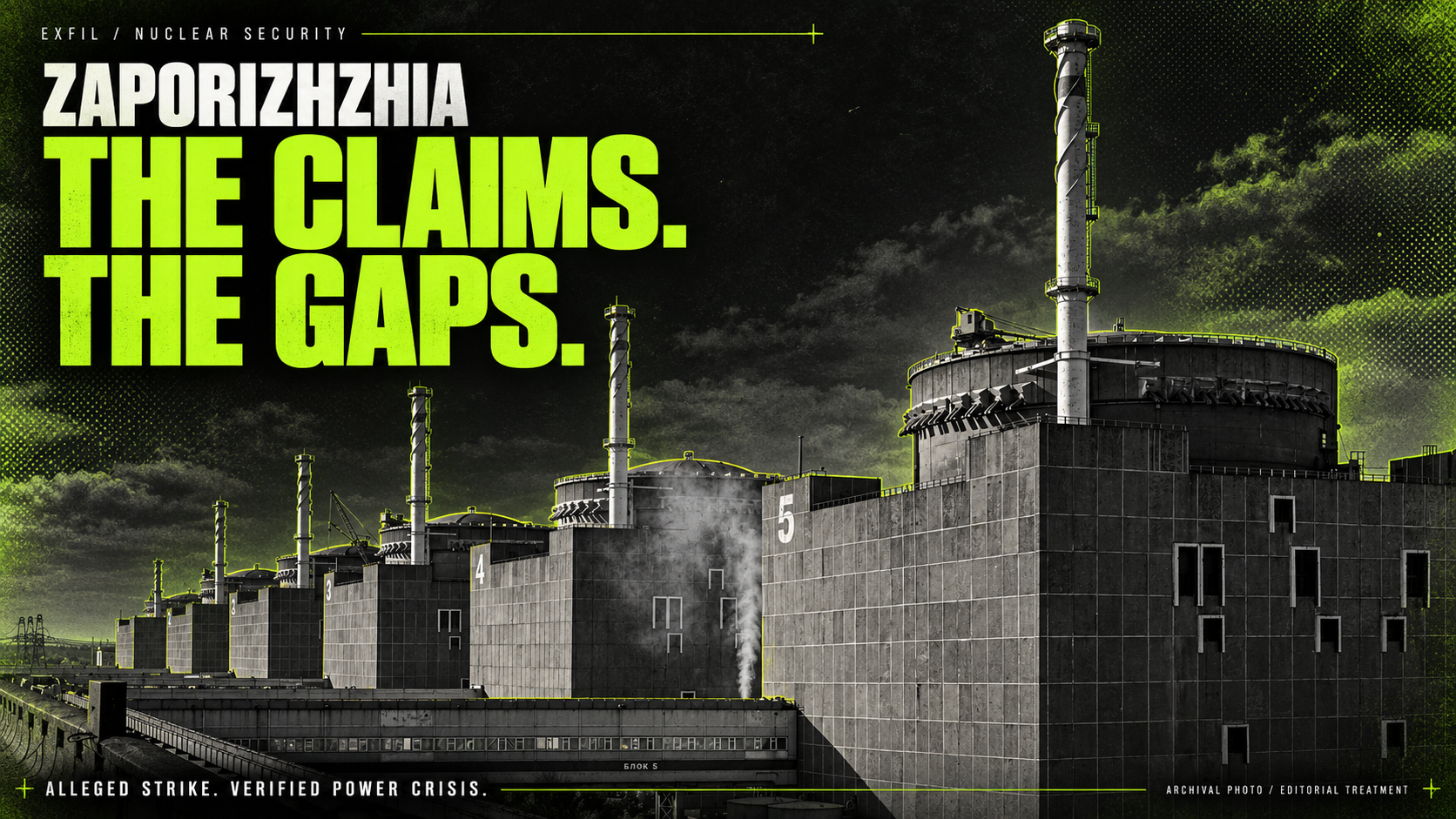
Russian officials say drones hit two buildings at Europe’s largest nuclear power plant. Independent confirmation remains missing, while international inspectors document an increasingly fragile electricity supply.
.jpg)
A damaged laboratory. A radioactive-waste building. A driver killed while delivering supplies. Reports surrounding the latest alleged attack on Zaporizhzhia combine several alarming claims. Examined separately, they describe different places, different consequences and an incident whose essential facts remain unverified.
International coverage has amplified those accounts, but has not supplied independent corroboration. The distinction matters at a nuclear facility where the documented safety problems are already serious enough.
The allegation—and where the accounts diverge
The plant’s management said drones struck laboratory and amenities building No. 2, approximately 200 metres from reactor Units 4 and 5, and the radioactive-waste processing building. Its Telegram announcement, posted at 6:46pm Sydney time on 5 October, reported roof damage, no casualties and radiation within prescribed limits. It blamed Ukrainian forces. [Plant management]
Rosatom chief Alexei Likhachev described an overnight attack on both buildings. According to Kommersant, he said both roofs were damaged and nuclear safety was not threatened. Those are statements by the organisation overseeing the occupied plant, rather than an independent assessment of the damage or responsibility. [Kommersant]
Russian foreign ministry spokeswoman Maria Zakharova dated the attack to 4 October and mentioned the laboratory building without referring to the waste-processing facility. An overnight incident can produce different calendar descriptions, and a shorter statement can omit a location. These differences warrant clarification; they do not, by themselves, prove fabrication. [TASS]
A death elsewhere becomes part of the story
Reuters, citing Likhachev, reported that a driver delivering food for plant employees was killed “in the drone attack”. The plant’s own separate announcement placed the fatal incident near Melitopol: it said a drone hit a supply vehicle travelling towards Enerhodar on 4 October. Its statement about the buildings at the nuclear site explicitly reported no casualties. [Reuters] [Plant’s driver announcement]
Readers should therefore distinguish the alleged strike at the plant from the separately reported death of a supplier elsewhere. Neither account independently establishes who was responsible.
What the evidence establishes
| Issue | Position at the reporting cutoff |
|---|---|
| October strike | Russian allegation. Independent confirmation of the damage and responsibility remains absent from the sources reviewed. |
| Driver’s death | The plant’s management describes a separate incident near Melitopol, rather than a casualty inside the nuclear site. |
| Radiation | Newer readings are available and reported as normal. Monitoring cannot establish whether a building was hit. |
| Power supply | The IAEA documents a single external connection, low diesel reserves and reduced automatic generator standby. |
There is also an information campaign to examine. On 4 October, RIA Novosti carried an allegation, attributed to a Russian security source, that Ukraine planned to stage attacks on electricity infrastructure associated with Zaporizhzhia and blame Russia. Ukraine’s Centre for Countering Disinformation warned that such messaging could prepare an explanation for Russian provocations. Russian reports of the alleged plant attack followed the next day, a sequence documented by Ukrainian public broadcaster Suspilne. [Suspilne]
That chronology deserves scrutiny. It does not establish that the subsequent incident was staged. Ukraine’s warning is an attributed assessment, and the physical claims still require evidence: access to the affected buildings, a reliable timeline and an independent account of what inspectors observed.
The IAEA’s latest numbered Ukraine statement remains Update 369, dated 2 October. It predates the alleged attack. The agency subsequently discussed reported September drone incidents and negotiations over repairs, but those communications should not be read as confirmation of the October claim. [IAEA register]
Newer radiation readings, with limits
Available information now extends beyond 1 October. Energoatom’s bulletin dated 6 October lists Zaporizhzhia readings obtained from the IAEA’s International Radiation Monitoring Information System on 5 October: 0.13 microsieverts per hour at the industrial site, 0.11 in the sanitary protection zone and 0.10 in the supervised area.
Energoatom describes the background as consistent with normal conditions. Its table nevertheless leaves emissions data unavailable, attributing the gap to the disconnection of the plant’s data-transmission systems by Russian occupation authorities. [Energoatom]
Separately, a regional public-health bulletin dated 6 October reports normal background readings at monitoring points in Zaporizhzhia city and Vilniansk. Those measurements concern the named locations, rather than a physical inspection of the nuclear plant. [Regional monitoring bulletin]
These readings provide reassurance within their coverage. They cannot determine whether a roof was hit, identify a drone’s operator or establish the condition of every safety system.
The documented power crisis
Although all six reactors are shut down, nuclear fuel still needs cooling and safety equipment still needs power. In its 25 September update, the IAEA reported that just four of the site’s 20 emergency diesel generators were configured to start automatically following another loss of external electricity. Other available generators would require manual connection; two were unavailable because of maintenance.
The reduced automatic response was a fuel-conservation measure. It should not be misreported as evidence that only four generators function. [IAEA Update 368]
One external power line. Low diesel reserves. Less capacity on automatic standby.
By 2 October, the IAEA said management was considering reducing automatic standby capacity further. Diesel stocks remained low, deliveries were impeded by military activity, and the plant depended on a single external connection: the 330 kV Ferosplavna-1 line. [IAEA Update 369]
That vulnerability has already been tested. The IAEA says external power was lost on 20 August and restored on 7 September after repairs under a local ceasefire. It was the plant’s 26th complete loss of off-site power during the conflict. Emergency generators carried essential systems for nearly three weeks, depleting the fuel needed for the next interruption. [IAEA Update 366]
A repair ceasefire remains the immediate test
The neighbouring thermal power plant is part of this problem. In an October statement reported by Anadolu, the IAEA said it had been informed of drone attacks there on 19, 20 and 27 September that damaged transformers important to Zaporizhzhia’s external supply. It did not identify the attacker.
Rafael Grossi was negotiating what would be an eighth local ceasefire to permit repairs, with the aim of starting “very soon”. No commencement announcement was identified in the sources reviewed for this feature. [Anadolu]
Earlier Russian explanations for electrical damage have faced substantive challenge. A Greenpeace investigation published on 17 September, drawing on satellite analysis by McKenzie Intelligence Services, disputed Russian accounts of Ukrainian attacks on the Ferosplavna switchyard in February and June. The analysis said damage attributed to the June incident was visible beforehand. Greenpeace accused Russia of sabotage. Those findings concern earlier incidents and cannot settle the October allegation. [Greenpeace]
Meanwhile, Likhachev says Rosatom has an internally approved plan for a phased reactor restart once military risks are removed. That approval describes Rosatom’s intentions; it does not demonstrate that the conditions for a safe restart exist. [Interfax]
The next meaningful developments will be verifiable ones: an IAEA inspection account addressing the alleged damage, clarification of the conflicting incident descriptions, replenished diesel supplies and completed electrical repairs. Until then, the October strike remains a Russian allegation against the backdrop of a nuclear safety crisis the IAEA has already documented.
Source note: Links accompany the claims they support. Statements by Russian officials, the plant’s management and Ukrainian authorities are attributed. Greenpeace’s satellite analysis concerns earlier incidents. Absence of independent confirmation is not proof that no strike occurred.
Time note: Clock times are Sydney time. Dates attributed to statements retain their source wording. This feature reflects the 7 October 2026 reporting cutoff and is not a continuously updated news feed.
Image: View the archival source photograph · Photo and adapted artwork: CC BY-SA 4.0