EXFIL NEWS / INTELLIGENCE
Germany’s former spy chief and the alleged trade in 2,000 BND documents
August Hanning is suspected of buying intelligence from his former office head and using it in private consulting. Reports of an Azerbaijani connection have drawn a denial, while German prosecutors have yet to name a country.
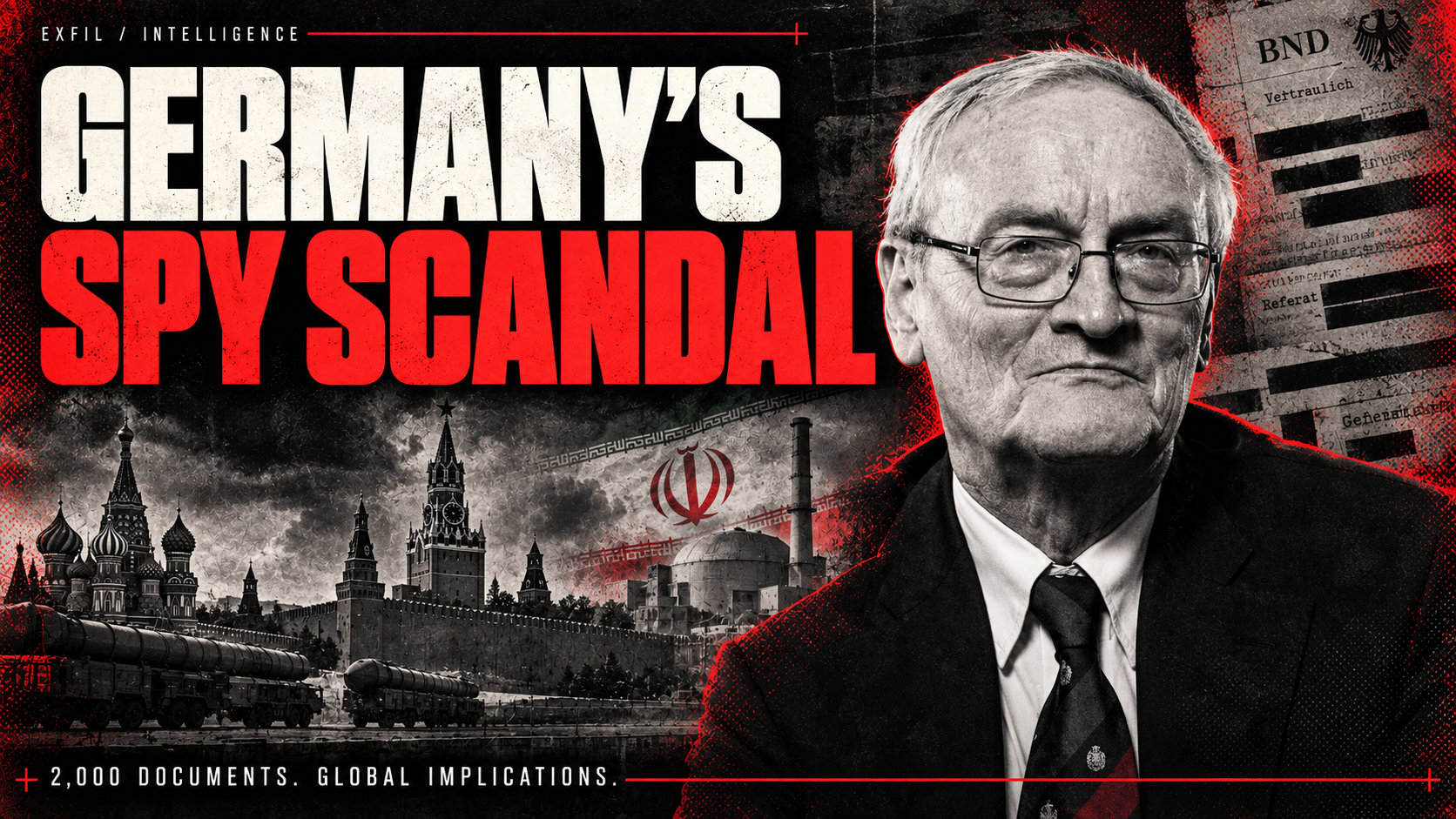
August Hanning once ran Germany’s foreign intelligence service. On 6 October, German authorities arrested him on suspicion of obtaining state secrets, espionage and attempted treason. At the centre of the investigation is an alleged arrangement through which his former office head supplied him with roughly 2,000 BND documents after he had left the agency.[1]
The arrest is confirmed. The accusations remain allegations. The Guardian reports that Hanning and his lawyers deny them.[2] Neither an arrest nor a decision to hold a suspect in custody establishes guilt.
There has already been a procedural development: Hanning’s former office head, identified as Manfred D., has been remanded in custody. Hanning was due before an investigating judge at the Federal Court of Justice in Karlsruhe on 7 October. At this article’s reporting cutoff, the latest verified report still described that decision as pending.[3]
Why this reaches beyond Germany
The Bundesnachrichtendienst, or BND, gathers and assesses foreign intelligence relevant to Germany’s foreign and security policy. It sits within the Federal Chancellery’s area of responsibility. Its assessments help inform the government’s understanding of threats and events overseas.[4]
According to the joint reporting of NDR, WDR and Süddeutsche Zeitung, published by Tagesschau, the documents allegedly passed to Hanning included sensitive material concerning Iran’s nuclear programme and the Russian military. Security sources told the reporters that some information originated with foreign partner services.[5]
That makes the potential consequences international. If shared intelligence was exposed, partner agencies would have to assess the risk to their own information. A loss of confidence in Germany’s safeguards could also affect future exchanges. These are potential consequences of the alleged breach, not evidence that allies have already restricted cooperation.[6]
The alleged route out of the BND
Prosecutors describe a relationship extending across several senior government appointments. Manfred D. had been Hanning’s office head at the BND and accompanied him to the Interior Ministry after Hanning left the intelligence service in 2005. From March 2012 until March 2026, D. again worked as office head for successive BND presidents, giving him access to sensitive material.[7]
The suspected arrangement dates to spring 2010. Prosecutors allege that D. agreed to provide valuable BND intelligence for payment, with Hanning intending to profit from it through his private consulting work. They put the volume at approximately 2,000 documents, many containing classified information, including material intended for senior intelligence meetings at the Chancellery.[8]
The reported document trail runs to June 2022. D.’s continued employment until March 2026 does not, by itself, establish that documents were being supplied throughout that later period.[3]
Hanning’s move into commercial intelligence is documented separately. CORRECTIV reports that he founded Hanning Consult with his wife in July 2010 and subsequently held roles with other security and intelligence consultancies. Those business activities provide context for the prosecution’s theory; they do not independently prove the alleged offences.[9]
Two foreign contacts and an unconfirmed country
The prosecution’s account contains two distinct strands. In one, Hanning allegedly used classified material to prepare an analysis for an officer of a foreign intelligence service. Investigators have not established whether that analysis reached its intended recipient. Separately, he allegedly supplied political information over several years to a representative of another foreign intelligence service, drawing partly on material from D.[8]
German prosecutors have not publicly named either service. Der Spiegel reported that the officer for whom the analysis was allegedly prepared was Azerbaijani, according to accounts of its reporting published by AFP and Tagesspiegel. That identification remains a media report, rather than a publicly confirmed finding by the prosecutor.[7][10]
Tagesschau’s original investigation also reported that the service connected to the alleged security analysis was not Russian. That does not identify the other service mentioned by prosecutors, or establish where every item of information ultimately went.[5]
On 7 October, Azerbaijan’s Media and Broadcasting Council rejected reports linking the country to the investigation, describing them as disinformation and alleging a campaign to damage Azerbaijan-Germany relations. Trend and Azernews published the council’s response. It is a denial from that body, not a finding by the German investigators.[11]
The figure of 2,000 documents concerns the alleged transfer from D. to Hanning. It should not be read as an established transfer of 2,000 documents to Azerbaijan, or to any other foreign government.
A kidnapping investigation opened the trail
The path to the espionage inquiry began with another case. In September 2025, investigators searched Hanning’s property in connection with the Christina Block investigation, which concerns allegations surrounding the seizure of her children from Denmark.
NDR, WDR and Süddeutsche Zeitung report that an electronic storage device recovered during those searches contained sensitive BND documents. The material was passed to federal authorities, and the federal prosecutor opened a covert investigation in May 2026. Hanning denies involvement in an earlier attempted kidnapping described in that reporting.[5]
Read the full background: The kidnapping case that opened the trail to Germany’s former spy chief.
The questions now facing Berlin
BND president Martin Jäger has said the agency conducted extensive internal investigations when suspicions arose, before federal prosecutors took over. He has stressed that internal security allows no compromises.[10]
The political response is also moving beyond the two suspects. Marc Henrichmann, who chairs parliament’s intelligence oversight committee, has questioned whether restrictions on former officials’ subsequent work are sufficient. Politicians from the SPD and Greens have called for tighter rules, including restrictions on private security consulting and lobbying.[3]
For the investigation, the unresolved questions are concrete: which information reached foreign recipients, which services were involved, how the documents left the BND, and what damage followed. For Germany’s partners, the concern is whether intelligence entrusted to Berlin remained protected.
The next court decision will determine Hanning’s custody status. Establishing the full extent of any breach, and the criminal responsibility of either suspect, will require considerably more than the arrest announcement.
Sources and reporting notes
Dates below are publication dates. Allegations are attributed to prosecutors or to the outlet reporting them. Analysis of possible consequences is conditional.
- Reuters via ABC News, 7 October: arrest, suspected offences and alleged document supply.
- The Guardian, 6 October: Hanning’s and his lawyers’ denial.
- Tagesschau, 7 October, 08:06 German time: D.’s remand, Hanning’s scheduled hearing, June 2022 document cutoff and political reaction.
- BND Act, section 1: the service’s statutory remit and institutional position.
- NDR/WDR/Süddeutsche Zeitung reporting via Tagesschau, 6 October: reported contents, partner intelligence, discovery during the Block investigation and the report excluding Russia from the analysis allegation.
- Deutsche Welle, 6 October: potential implications for partner confidence and intelligence sharing.
- Tagesspiegel / AFP, 6 October: D.’s employment history and attribution of the Azerbaijan allegation to Spiegel.
- Federal prosecutor, 6 October: original release; text checked through its news.de/AOL republication. The original host could not be retrieved during preparation. Covers the alleged paid arrangement and the two separate foreign-service contacts.
- CORRECTIV, 6 October: Hanning’s consulting businesses.
- AFP, 6 October: Spiegel’s Azerbaijan report and Jäger’s response. Spiegel’s original article was not directly retrievable; its allegation is attributed through AFP and Tagesspiegel.
- Trend, 7 October, 10:51 UTC+4, and Azernews, 7 October, 11:26 UTC+4: the Azerbaijani Media and Broadcasting Council’s rejection of the reports.
This feature describes an ongoing investigation. Neither suspect’s guilt has been established. Custody status and country attribution should be checked against subsequent announcements before republication.